Blog
Louis Vuitton Collaborations
By
Asiya
| SEO & Content Strategist, Value Creation
Published on 17 Sep, 2026 |
Last updated at 18 Sep, 2026
Louis Vuitton collaborations have changed the look of some of the house's most familiar designs. Stephen Sprouse wrote across the Monogram in graffiti, Takashi Murakami filled it with colour, and Yayoi Kusama brought her dots to bags, shoes and ready-to-wear.
Those projects are often grouped, but they did not all work in the same way. Some were artist collaborations. Supreme and Nike were brand partnerships. Celebrating Monogram brought several creators together for one anniversary project, while Artycapucines became an ongoing artist-edition programme.
That difference is useful when looking at a pre-owned piece. It helps place a bag in the right release, separate an original collection from a later tribute or re-edition, and understand why two pieces carrying the same collaborator's name can belong to different periods.
How Louis Vuitton's Major Collaborations Unfolded
2001: Stephen Sprouse

Graffiti lettering overlaid the traditional Monogram, creating one of the clearest starting points for Louis Vuitton's modern-era artist collaborations.
2003: Takashi Murakami

Monogram Multicolore introduced a radically brighter palette to familiar Louis Vuitton bags and later expanded to include motifs such as Cherry Blossom, Superflat Panda, and Cerises.
2008: Richard Prince

Watercolour effects, text and layered finishes gave the Monogram a softer, more painterly look.
2012 and 2023: Yayoi Kusama

Two separate collaborations brought dots, pumpkins and other Kusama motifs into Louis Vuitton collections more than a decade apart.
2017: Supreme

Louis Vuitton paired its Monogram with Supreme's streetwear identity across bags, trunks, clothing and accessories.
2017: Jeff Koons

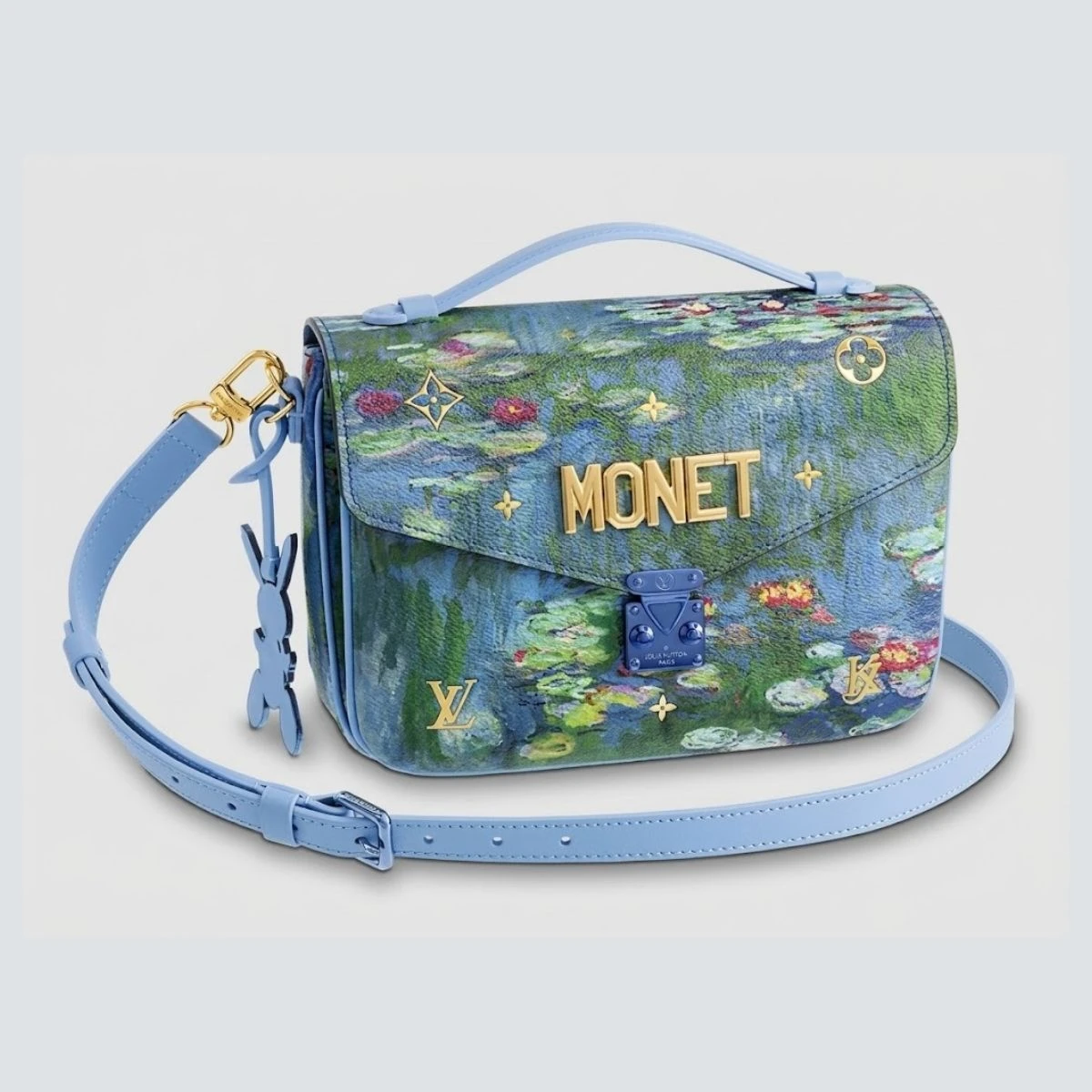
The Masters project placed reproductions of historic paintings and large metallic artist names across familiar Louis Vuitton bag shapes.
2021: Urs Fischer

Fischer redrew the Monogram in a deliberately loose, hand-drawn style.
2022: Nike, led by Virgil Abloh

The Air Force 1 was reworked through Louis Vuitton materials, Monogram and Damier details.
What Counts As A Louis Vuitton Collaboration?
Louis Vuitton has worked with outside creatives in several ways. Artist collaborations often reinterpret a house code, especially the Monogram. Stephen Sprouse, Takashi Murakami, Richard Prince, Yayoi Kusama, Jeff Koons, Jake and Dinos Chapman, and Urs Fischer fit that pattern.
Fashion partnerships can be more structural or editorial. Rei Kawakubo changed the form of familiar bags, Grace Coddington brought her illustrations into a Cruise collection, and the Fornasetti project drew from the Italian atelier's archive.
Brand collaborations combine two established identities. Supreme brought its streetwear branding into Louis Vuitton leather goods and ready-to-wear, while Virgil Abloh reworked Nike's Air Force 1 through Louis Vuitton materials and house signatures.
Other projects sit beside those categories without being the same thing. Celebrating Monogram was a six-creator anniversary project.
Artycapucines is a recurring artist programme built around one bag. Keeping those labels separate makes the history easier to follow.

The Collaborations That Changed Louis Vuitton's Monogram
Stephen Sprouse Made Graffiti Part Of The House Code
Stephen Sprouse's 2001 project is one of the key starting points for Louis Vuitton's modern era of high-profile artist collaborations. During Marc Jacobs's tenure, Sprouse placed loose graffiti lettering over the traditional Monogram canvas.
The brown canvas stayed visible beneath the writing. That contrast gave a familiar house code a much less formal look, and the treatment appeared across pieces such as the Speedy, Keepall and Pochette.
Louis Vuitton's own history of its artistic collaborations places Sprouse's 2001 Monogram reinterpretation among its major modern projects.
It also notes that the house's artistic collaborations reach back to 1910, so Sprouse should not be described as Louis Vuitton's first-ever collaborator.
Louis Vuitton returned to Sprouse's visual language in 2009. The later release brought back fluorescent graffiti and introduced large rose motifs across bags, shoes, and ready-to-wear.
Sprouse had died in 2004, which makes the 2009 chapter a posthumous tribute rather than a newly co-created collaboration.
On the pre-owned market, a 2001 Graffiti piece and a 2009 Roses or fluorescent Graffiti piece belong to different releases even though both come from the same creative story.
Takashi Murakami Changed The Colour Of Louis Vuitton
Takashi Murakami's work appeared in Louis Vuitton's Spring/Summer 2003 collection, shown in October 2002, with Monogram Multicolore becoming the partnership's best-known design.
Instead of the usual tonal palette, Murakami spread brightly coloured LV initials and flowers across black or white backgrounds. The treatment appeared on familiar shapes including the Speedy, Alma and Keepall, along with smaller leather goods.
The wider partnership also produced Cherry Blossom, Superflat Panda and Cerises designs. Each has its own visual identity, which is why Louis Vuitton x Murakami covers far more than Multicolore alone.
The original partnership continued into 2015. Louis Vuitton later returned to Murakami with an official re-edition of the collaboration, bringing Multicolore, Superflat Panda, Cherry Blossom and Cherry motifs onto newer bags and accessories.
The production period therefore matters. An early-2000s Multicolore bag and a newer re-edition may share the same artwork, but they are not the same generation.

Richard Prince Gave Monogram A Watercolour Finish
Richard Prince's work entered Louis Vuitton's Spring/Summer 2008 collection during the Marc Jacobs era. The result was softer and more layered than the sharp graphics of Sprouse or Murakami.
Some bags used washed, watercolour-like Monogram effects. Others brought in text, joke elements, and more complex surface treatments. The Aquarelle look is one of the clearest visual cues from this period.
Vogue's Spring 2008 Louis Vuitton coverage places Prince's work within that collection. When identifying a pre-owned piece, the finish of the canvas, trim, and bag shape are more useful than treating every Prince-related product name as an official collection title.
Yayoi Kusama Has Two Distinct Louis Vuitton Chapters
Louis Vuitton first worked with Yayoi Kusama in 2012. Her dot-based visual language appeared across bags, clothing, shoes, and accessories during the Marc Jacobs era.
The house returned to Kusama in 2023 for a second major collaboration. It was not simply a reproduction of the 2012 collection.
The later chapter used Painted Dots, Infinity Dots, metallic treatments, pumpkins, faces, and other motifs across a new product range.
That makes the year important. A dotted Louis Vuitton bag from 2012 and one from 2023 belong to different collections, even when the artist's visual language is immediately recognizable.
The same principle applies to other older releases. When a familiar bag appears in several periods, Louis Vuitton bag size differences can help separate the silhouette itself from the collaboration treatment applied to it.
Other Artist Collaborations Collectors Should Know
Jeff Koons Turned Famous Paintings Into Bag Designs
Jeff Koons's Masters project arrived in 2017. Rather than changing the Monogram alone, the bags placed reproductions of historic paintings across Louis Vuitton shapes and added large metallic artist names to the front.
Works associated with Leonardo da Vinci, Titian, Rubens, Fragonard and Van Gogh appeared in the first release, with later works expanding the project. Speedy, Neverfull and Keepall styles are among the familiar Louis Vuitton forms linked with Masters.
Koons collaborated with Louis Vuitton. The historic painters whose works appeared on the bags were the subjects of the project, not collaborators themselves.
For an older Masters piece, identifying the artwork and release chapter is more precise than calling it simply a Louis Vuitton art bag.
Jake And Dinos Chapman Brought Surreal Animals Into Menswear
Jake and Dinos Chapman worked with Louis Vuitton during Kim Jones's menswear years. Their work appeared in more than one period, so the earlier 2013 project should be kept separate from the Spring/Summer 2017 collection.
The 2017 chapter is especially recognizable for surreal safari-animal imagery. Lion, elephant, and rhino-style drawings appeared across menswear and accessories.
Vogue's coverage of the Spring 2017 menswear collection connects the work to Kim Jones and the Chapman brothers' animal imagery. It also widens the collaboration story beyond women's handbags, since luggage and men's accessories form an important part of the archive.
Urs Fischer Redrew The Monogram From Memory
Urs Fischer's 2021 collaboration is less famous than Murakami or Kusama, but its Monogram is hard to mistake once you know the design.
Fischer redrew the LV initials and flowers in a loose, uneven hand. The shapes look deliberately imperfect, almost as though the logo had been sketched from memory.
The capsule used black and red as well as black and white treatments across bags, ready-to-wear, shoes and accessories. Some special-edition bags also used textured tuffetage, which gave the drawings a raised finish.
It is a distinctive modern reinterpretation that receives far less attention than the better-known early-2000s collaborations.

Designer And Fashion-World Collaborations
Rei Kawakubo Changed The Bag Itself.
Louis Vuitton worked with Rei Kawakubo and Comme des Garçons in 2008 on a limited project tied to Louis Vuitton's history in Japan.
Kawakubo's approach was more structural than decorative. Instead of placing another print over the Monogram, she altered the familiar bag form.
Later Rei Kawakubo and Louis Vuitton pieces also exist, including versions associated with the Bag With Holes concept. Those later editions should not automatically be folded into the original 2008 project. The year and exact release still need to match the piece being described.
Celebrating Monograms Gave Six Creators One Brief.
In 2014, Louis Vuitton marked the Monogram with a project involving Christian Louboutin, Cindy Sherman, Frank Gehry, Karl Lagerfeld, Marc Newson and Rei Kawakubo.
Each creator answered the brief differently. The results included Karl Lagerfeld's Punching Trunk, Christian Louboutin's shopping-bag concept, Cindy Sherman's camera-inspired piece, and Marc Newson's backpack.
Vogue's coverage of Celebrating Monogram presents the six as individual creators reinterpreting the house code. The six pieces came from the same anniversary brief, but each creator interpreted the Monogram in a very different way.
Grace Coddington Turned Pets Into Catogram.
Grace Coddington's Catogram work appeared in the Cruise 2019 collection with Nicolas Ghesquière.
Her drawings of cats Pumpkin and Blanket were joined by Ghesquière's dog Léon. The animals appeared across handbags, leather goods, ready-to-wear and accessories, with Speedy, Neverfull and Petite Malle styles among the recognizable bag associations.
Once the animals behind the print are familiar, Catogram is relatively easy to place. Coddington's role also shows why "artist collaboration" can sometimes be too narrow a label.
Her career spans fashion editing, styling and illustration, so fashion-world collaboration describes the project more accurately.
Fornasetti Brought An Archive Into Louis Vuitton
For Fall/Winter 2021, Louis Vuitton worked with the Fornasetti atelier. Nicolas Ghesquière drew from the Italian design house's archive for architectural, classical, and surreal imagery across clothing, bags, and accessories.
The project should be described as a collaboration with the Fornasetti atelier or design house, not as a personal collaboration with founder Piero Fornasetti, who died in 1988.
Its dense architectural imagery also gives the collection a very different character from the logo-led treatments associated with Sprouse, Murakami, or Supreme.
Louis Vuitton Brand Collaborations That Crossed Into Streetwear
Louis Vuitton X Supreme Brought Two Logos Into One Collection
Louis Vuitton x Supreme arrived in 2017 under Kim Jones. The partnership brought Supreme's branding into Louis Vuitton bags, luggage, clothing, and accessories.
The red-and-white co-branded Monogram became the clearest signature. Keepall 45 bags, trunks, wallets, and the Boîte Skateboard Trunk are among the pieces closely linked with the collection.
Supreme stands apart from an artist repainting or redrawing the Monogram. Both brands remained immediately visible, which is a large part of why the collection is still so easy to recognize.
Virgil Abloh Reworked The Nike Air Force 1 For Louis Vuitton.
Virgil Abloh created the Louis Vuitton x Nike Air Force 1 for the house's Spring/Summer 2022 men's collection. The project combined Nike's familiar sneaker shape with Louis Vuitton Monogram, Damier, leather, and Abloh's quotation-mark details.
The runway included 47 pairs, but the later auction and retail releases need to be treated separately. Sotheby's offered 200 pairs in the first auction release in early 2022. Those pairs came with orange Monogram Taurillon pilot cases made specifically for that sale.
The Sotheby's Louis Vuitton x Nike catalogue documents the 200-pair auction edition and its presentation. The orange pilot case should not be described as standard packaging for every Louis Vuitton x Nike Air Force 1.
A pre-owned pair should therefore be identified by its exact release, not simply by the broad "LV x Nike" label.
How To Recognize A Louis Vuitton Collaboration Piece
Read The Motif Before The Bag Model
Start with the artwork. The Speedy alone will not tell you much because Louis Vuitton has used the same silhouette across standard lines and many special collections.
Sprouse points toward graffiti or roses. Murakami is linked with Multicolore, cherries, blossoms,s and character motifs. Kusama is strongly tied to dots and pumpkins, while Koons uses reproduced paintings and metallic artist names.
Catogram uses illustrated pets. Urs Fischer turns the Monogram into a loose sketch. Supreme is much more direct, with visible co-branding.
Some familiar collaboration bags are also discontinued Louis Vuitton styles. That can explain why a particular model or motif now appears mainly through vintage and pre-owned sellers.
Separate The Original Release From Later Chapters
The most useful date checks are often simple:
Sprouse 2001 versus the 2009 tribute
Kusama 2012 versus the 2023 second collaboration
Original Murakami pieces versus the 2025 re-edition
Nike runway, Sotheby's auction, and later retail releases
These are not minor naming differences. They affect what materials, packaging, product names, and design details should make sense for a particular piece.
Keep Provenance, But Do Not Treat It As Proof.
Receipts, tags, dust bags, boxes, locks, keys, artist cards, and collaboration-specific packaging are worth retaining when they came with the item. They can help document how the piece was sold and make a set more complete.
They do not prove authenticity on their own. Packaging can be lost, replaced, or copied. The bag or accessory still needs to make sense in its construction, materials, and release details.
The same applies to Louis Vuitton authenticity details: collection identification and authentication are related, but they are not the same check.
Price should be kept separate too. A limited motif does not automatically make a bag an investment. Readers comparing a collaboration piece with standard models can use Louis Vuitton bag pricing as retail context, while Louis Vuitton resale factors belong to a different question.
Not Every Creative Project Belongs On The Same Collaboration List
Artycapucines is an ongoing artist-edition programme built around the Capucines bag. Different artists reinterpret the same model over time, so it makes more sense as a recurring programme than as a single collaboration.
Objets Nomades is another ongoing creative programme, but it focuses on furniture and functional design objects rather than handbag history.
Commercial partnerships such as Formula 1 belong in a different category as well. They may involve Louis Vuitton branding and design, but they do not work like an artist-led Monogram project or a fashion collaboration.
Specialist watchmaking projects sit outside this handbag-focused history for the same reason. A longer list is not necessarily a clearer one.
FAQs
Who has Louis Vuitton collaborated with?
Louis Vuitton has worked with artists, designers and brands including Stephen Sprouse, Takashi Murakami, Richard Prince, Yayoi Kusama, Jeff Koons, Rei Kawakubo and Comme des Garçons, Grace Coddington, Urs Fischer, Supreme and Nike.
The house has also run multi-creator and recurring projects such as Celebrating Monogram and Artycapucines.
When did Louis Vuitton collaborate with Takashi Murakami?
Murakami's work appeared in Louis Vuitton's Spring/Summer 2003 collection, shown in October 2002, and Monogram Multicolore became the partnership's best-known design. The wider partnership later included Cherry Blossom, Superflat Panda, and Cerises.
Louis Vuitton returned to Murakami with an official re-edition in 2025, so original-era and re-edition pieces should be identified separately.
Did Louis Vuitton collaborate with Nike?
Yes. Virgil Abloh designed Louis Vuitton x Nike Air Force 1 sneakers for the Spring/Summer 2022 men's collection.
Sotheby's later offered 200 pairs with orange Louis Vuitton pilot cases made specifically for that auction release. Later retail pairs should not automatically be described as having the same presentation.
Was Louis Vuitton x Yayoi Kusama 2023 a reissue?
No. The 2023 collection was a second major Louis Vuitton x Yayoi Kusama collaboration rather than a simple reproduction of the 2012 release.
Both chapters use Kusama's visual language, but the product ranges, treatments, and production periods are different.
Why The Release Matters As Much As The Collaborator
The collaborator's name may catch the eye first, but the release tells you what the piece is. Sprouse's 2001 Graffiti is different from the 2009 tribute, Kusama's 2012 collection is different from 2023, and an original Murakami bag is not the same generation as the 2025 re-edition.
That context is especially useful with pre-owned luxury bags, where pieces from several eras can appear side by side. The motif, model, release, and condition are all worth checking before price alone.
Owners considering a sale can use Value Creation's designer bags selling service for a quote and authentication process in Dubai.
More in The Journal
How Luxury Resale Has Changed in the Last 5 Years
The Real Difference between Burberry and Burberrys

Common Mistakes To Avoid When Selling Bags And How To Fix Them